
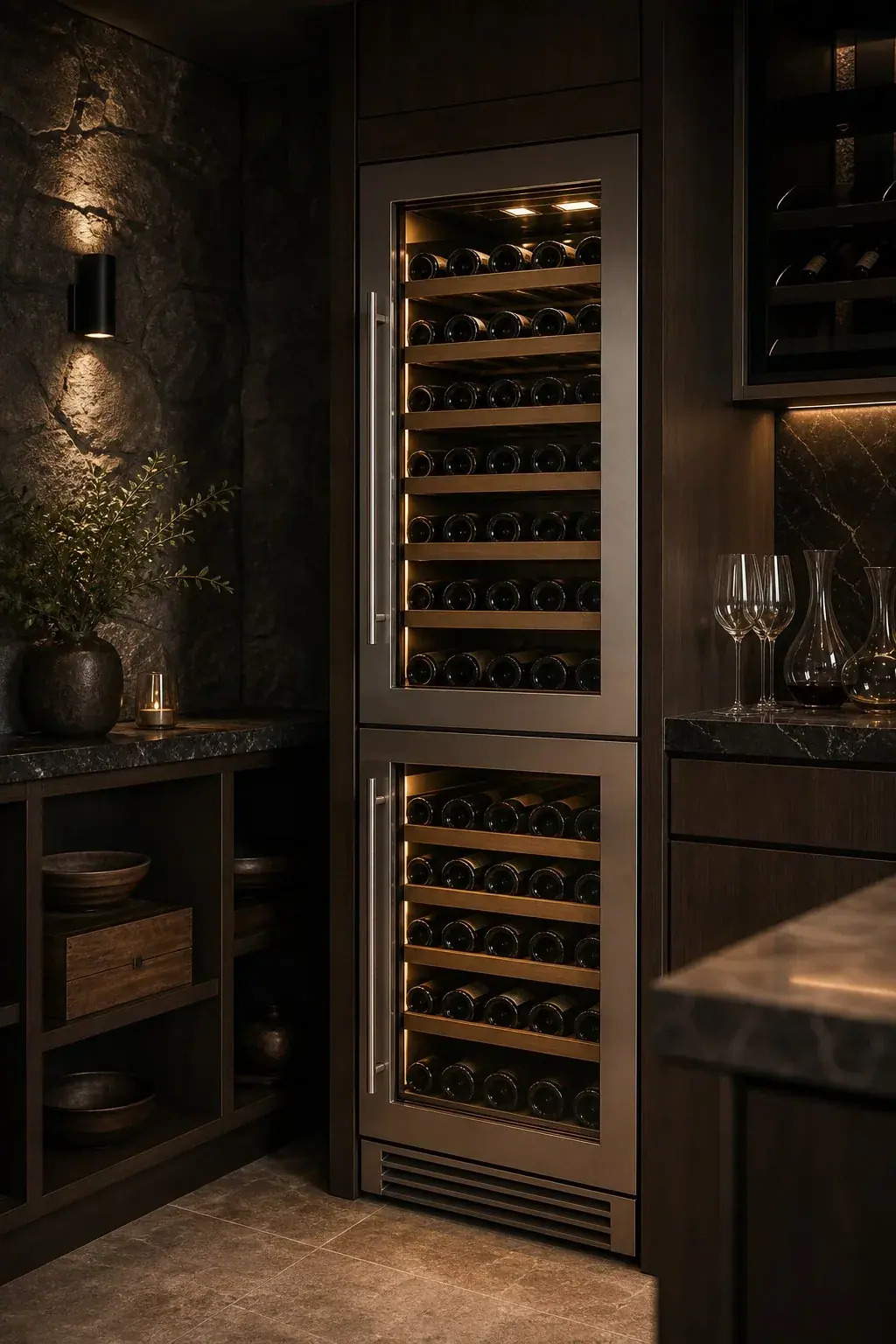
A serious cellar lives in a lot of San Ramon homes — a built-in Sub-Zero wine column tucked into the kitchen or a butler's pantry off the Blackhawk and Diablo estates, holding bottles that were never cheap to buy and won't be cheap to replace. So when one zone of a dual-zone unit starts reading two or three degrees off, it's worth understanding before you panic about the whole appliance.
Sub-Zero builds genuine wine storage — that's the brand, not Wolf — and a wine column fails differently than a refrigerator. The fix is almost always a bounded part, not a sealed-system rebuild. Here's what actually goes wrong in a Tri-Valley kitchen.
One zone holds, the other drifts
The whole point of a dual-zone column is two independent climates — reds nearer 60°F up top, whites and sparkling closer to the mid-40s below, or whatever split you set. Each zone runs off its own temperature sensor (a thermistor) and its own damper or zone fan feeding cold air from a shared evaporator. When one zone reads true and the other slowly climbs, the compressor and sealed system are usually fine — the problem is the part steering air into the drifting zone.
A failed thermistor mis-reports the temperature, so the control never calls for enough cooling. A tired zone fan or a stuck damper means the cold is there but isn't reaching the shelves. We diagnose which one by measuring actual zone temperatures against what the panel claims, because replacing the compressor on a stratified cabinet is the classic way to spend four figures fixing the wrong thing.
San Ramon heat and the glass door work against you
A wine column has a UV-tinted glass door — beautiful, and a far weaker thermal barrier than the insulated panel on a fridge. In a San Ramon summer, when the kitchen behind it is fighting 100°F afternoons and afternoon sun rakes across the cabinetry, that glass and its perimeter gasket are where the heat gets in. A gasket that's gone hard or a glass seal that's lost its edge lets warm room air bleed into the top zone first, which is exactly the zone people notice drifting.
The same inland dust the Diablo winds carry loads the condenser over a few seasons, so the unit runs warmer overall and has less margin to hold a tight wine temperature. A column that coped in spring can fall behind in August — and a wine cabinet has far less thermal mass than a stocked fridge, so it shows the drift faster.
Vibration, sediment, and knowing when to fix
There's one failure mode unique to wine: vibration. A compressor mount that's worn or a fan bearing starting to buzz sends a low hum through the cabinet, and constant micro-vibration disturbs the sediment in older bottles — the very thing you laid them down to let settle. If your column has started humming where it used to be silent, that's worth addressing before it costs you a vintage, not just the repair.
On repair versus replace: a built-in Sub-Zero wine column is a long-lived, panel-ready appliance designed around your cabinetry, and a sensor, fan, damper, or gasket is a clean, genuine-OEM repair that's a fraction of replacement — replacing means re-fitting the surround too. A failed sealed system on a very old unit is the one case worth weighing. We go diagnostic-first: zone temperatures, airflow, seal and vibration checks before any part is named, and the $89 service call is waived with the repair. Book online or call and we'll route a technician across San Ramon, Danville, Blackhawk, Diablo and Alamo.
Questions & answers
Does Sub-Zero actually make wine coolers?
Yes. Built-in wine storage is a core Sub-Zero line — dual-zone columns and undercounter units — separate from its refrigeration. (Wolf is the cooking brand; it doesn't make wine units.) We service Sub-Zero wine storage across the Tri-Valley.
My top zone is warm but the bottom is fine — is the compressor dead?
Almost certainly not. A single zone drifting while the other holds points to that zone's thermistor, fan or damper, or a worn door gasket on the glass — not the shared compressor. We confirm by measuring real zone temperatures before replacing anything.
Should I repair an older wine column or replace it?
Usually repair. A built-in column is fitted to your cabinetry, so replacement means re-doing the surround too, while a sensor, fan, damper or gasket is a bounded OEM fix. Only a failed sealed system on a very old unit makes replacement worth weighing.
More Tri-Valley guides
- Brand comparison · 3 minSub-Zero vs GE Monogram Built-Ins: A San Ramon Service-Bench ComparisonTwo built-in brands on one bench: what fails on a Sub-Zero and a GE Monogram as each ages, what the fixes cost, and who should genuinely buy which.Read the guide →
- Runs Constantly · 4 minWhy a Sub-Zero Runs Constantly in San Ramon (and When It's a Real Failure)A Sub-Zero running nonstop in San Ramon usually means a dusty condenser, weak door gasket, or low charge — not a failure. See the causes, DIY checks, and costs.Read the guide →
- Interior Airflow and Warm Spots · 3 minWarm Spots in a Packed Sub-Zero: An Interior Airflow Guide for San RamonWarm spots in a packed Sub-Zero usually mean blocked air vents, not a failed compressor. How San Ramon homes map, clear, and fix uneven cooling in built-ins.Read the guide →