
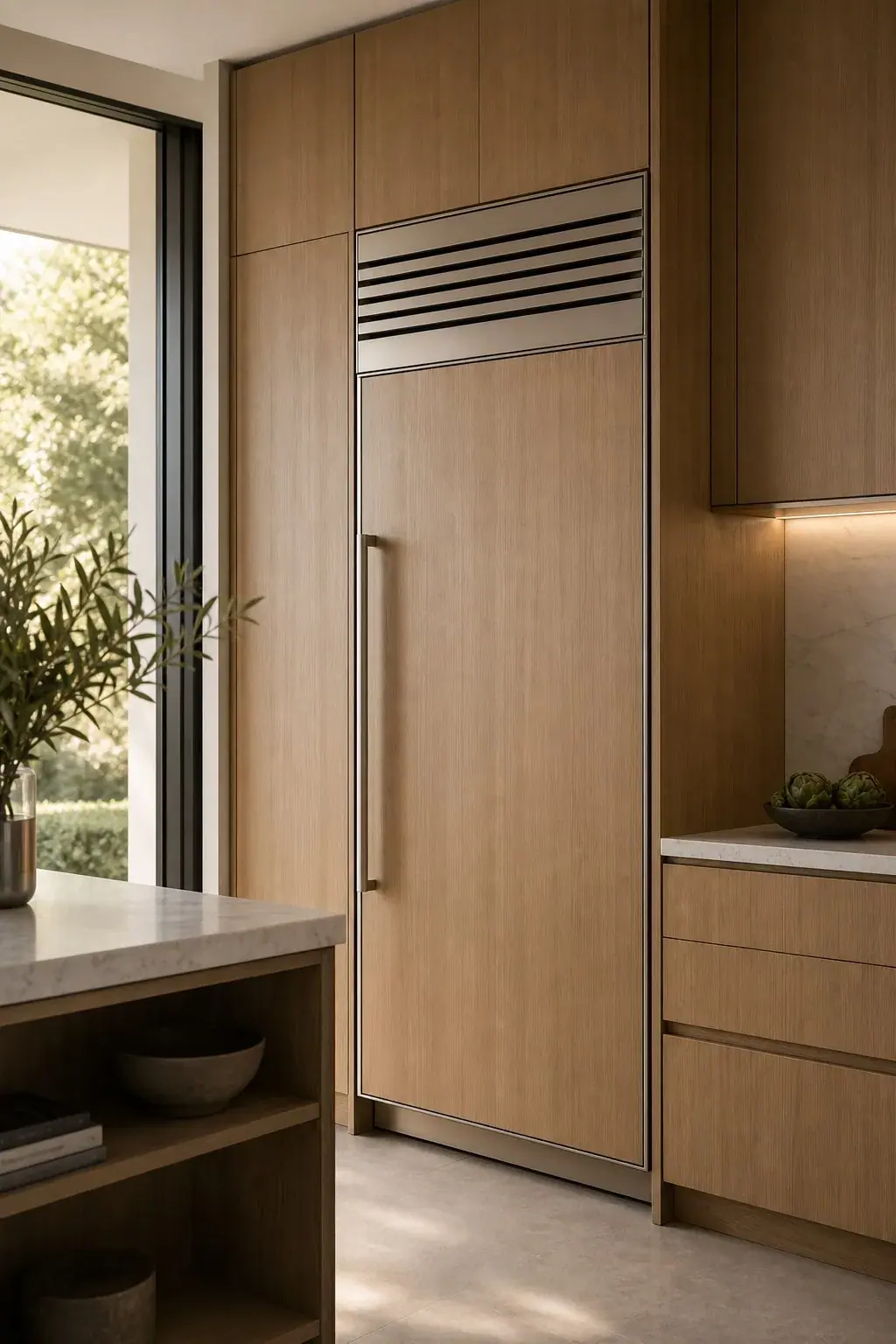
Across the San Ramon Valley — the gated streets of Blackhawk, the older estates of Diablo, the newer custom homes above Danville and Alamo — the built-in refrigeration is rarely a standalone box you can just roll out. It's a column paired with a freezer column, flanking a dual-zone wine unit, framed by panel-ready custom millwork that was designed around the appliance, not the other way around.
That changes the repair before any part is even diagnosed. Here is how an estate-kitchen call actually goes, and why the planning matters more than the wrench.
The cabinetry is the constraint, not the part
On a free-standing fridge you pull it out, work behind it, and slide it back. A Tri-Valley column or integrated unit is anchored into the surround, its custom panel attached to the door, with tolerances of a few millimeters to the adjacent cabinetry and a stone countertop overhanging the top grille.
Getting safe access means removing the right panels and grilles in the right order, protecting the floor and the cabinet faces, and knowing how the unit unseats without stressing a hinge or scratching a finish that costs more than the repair. The diagnosis is often the easy part; doing it without marking the kitchen is the skill.
Hillside access changes the logistics
Many of these homes sit up the slopes toward Mount Diablo, where the driveway is long and steep, parking near the door is tight, and the kitchen can be a level or two above the entry. Moving a heavy column unit, a compressor, or a sealed-system kit to that kitchen is half the job.
We plan routing and confirm the model and serial before the visit so the right parts arrive the first time. A hillside estate call that turns into two trips because of a missing part is exactly what careful prep prevents.
Wine units add a second set of rules
Estate kitchens here often pair the refrigeration with a built-in dual-zone wine unit, and those have their own failure pattern — a stratified cabinet where one zone holds and the other drifts, usually a failed zone evaporator fan, a thermistor, or a damper rather than the compressor. We diagnose the wine unit on its own terms, because treating it like a small refrigerator is how people end up replacing the wrong part.
How we keep an estate call clean
Every visit is diagnostic-first: model and serial, box and coil temperatures, airflow, and electrical readings before any recommendation. We protect surfaces, work to the cabinetry's tolerances, and use genuine OEM parts so the panel-ready unit goes back exactly as it was. The $89 service call is waived with the repair. Book online or call to schedule across San Ramon, Danville, Blackhawk, Diablo and Alamo.
Questions & answers
Do I need to remove my custom panels before you arrive?
No — please don't. Panel-ready and integrated units come apart in a specific order, and we handle the grilles and panels on site so nothing gets stressed or scratched. Just clear the area in front of the unit.
Can you service the built-in wine unit next to my fridge?
Yes. Built-in dual-zone wine units are squarely in what we repair. They have their own diagnostics — a zone that drifts is usually a fan, thermistor or damper — and we test before replacing anything.
More Tri-Valley guides
- Brand comparison · 3 minSub-Zero vs GE Monogram Built-Ins: A San Ramon Service-Bench ComparisonTwo built-in brands on one bench: what fails on a Sub-Zero and a GE Monogram as each ages, what the fixes cost, and who should genuinely buy which.Read the guide →
- Runs Constantly · 4 minWhy a Sub-Zero Runs Constantly in San Ramon (and When It's a Real Failure)A Sub-Zero running nonstop in San Ramon usually means a dusty condenser, weak door gasket, or low charge — not a failure. See the causes, DIY checks, and costs.Read the guide →
- Interior Airflow and Warm Spots · 3 minWarm Spots in a Packed Sub-Zero: An Interior Airflow Guide for San RamonWarm spots in a packed Sub-Zero usually mean blocked air vents, not a failed compressor. How San Ramon homes map, clear, and fix uneven cooling in built-ins.Read the guide →