
San Ramon sits in the warm inland pocket where the Tri-Valley meets the foot of Mount Diablo, and the weather here is nothing like the cool, damp microclimates a few ridges to the west. Summer afternoons push past 95°F along I-680, and when the Diablo winds turn offshore they drag dry, dust-laden air down off the open hills above Blackhawk and Diablo.
Those two facts — real heat and real dust — quietly decide how a built-in Sub-Zero ages in a San Ramon kitchen, and they explain a large share of the warm-running calls we take through the summer.
Dry inland dust cakes the condenser coil
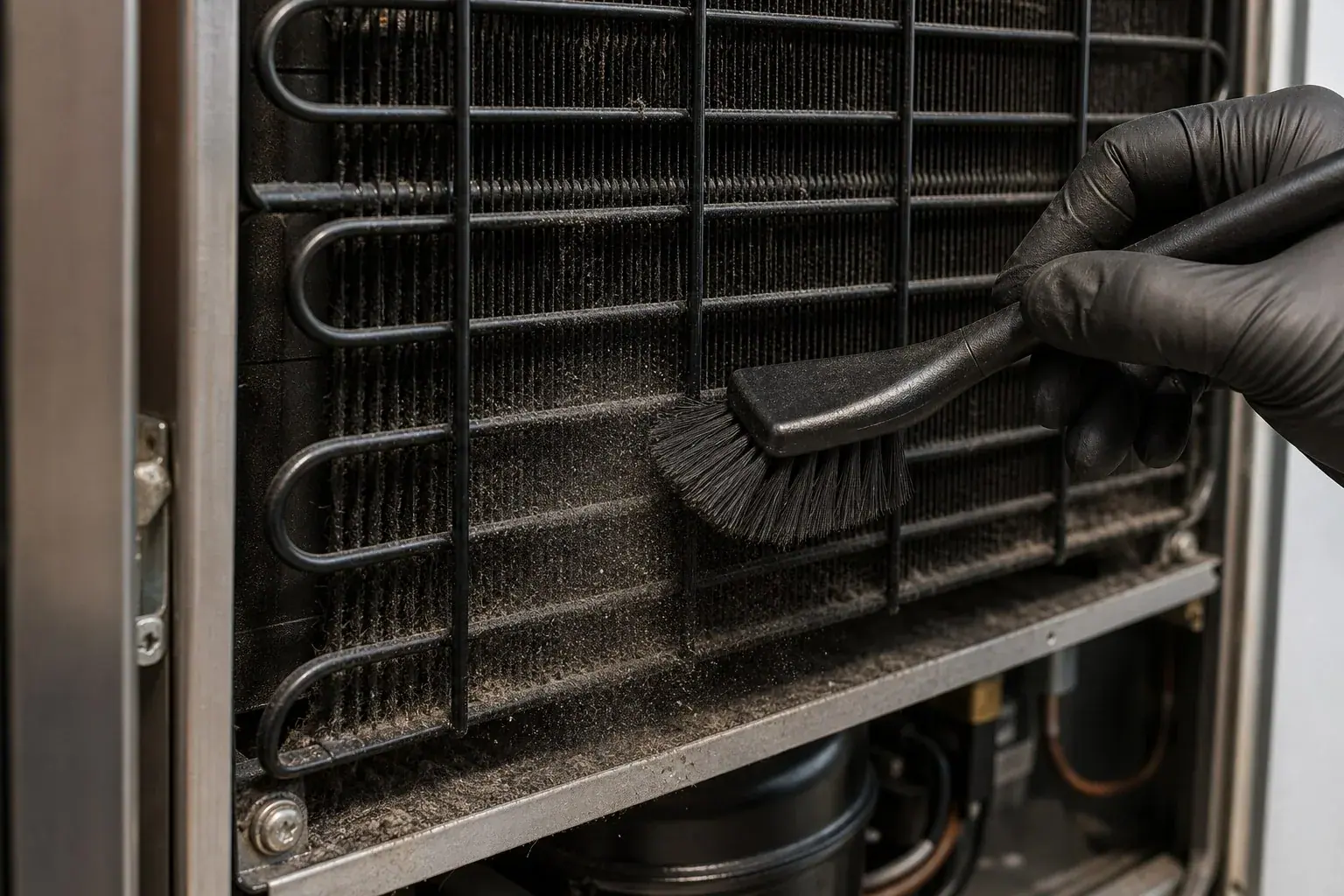
A built-in Sub-Zero sheds heat by pulling room air across a condenser coil behind the lower grille. In San Ramon that intake air carries the fine, dry grit the Diablo winds bring down off the grasslands — much more of it than a coastal kitchen ever sees. The grit packs into the coil fins and the cooling fan, and a clogged coil forces the compressor to run longer and hotter to hold the same box temperature.
After two or three dry inland summers that buildup is usually thick enough to measure. It is the single most common reason a Tri-Valley refrigerator that cooled fine in spring starts drifting warm by August.
The heat stacks the deck against a tired unit
Condenser performance falls as the air around the unit gets hotter, so a coil that copes in 70-degree weather can fall behind on a 100-degree San Ramon afternoon. A column or built-in tucked into tall cabinetry, with limited clearance above the grille, feels it first — the warm air it just expelled gets pulled straight back in.
The failure mode we see is gradual: the fresh-food side creeps from 38°F toward the mid-40s on the hottest days, ice production slows, and the compressor barely cycles off. None of it is dramatic, which is exactly why it gets ignored until food starts spoiling.
Once-a-year coil care is the highest-value move
For a San Ramon owner, a yearly condenser cleaning — ideally in late spring before the first heat wave — is the best dollar you can spend on the appliance. Clearing the coil and fan lets the compressor run cool again, and it catches a sweating door gasket or a struggling evaporator fan before either turns into a sealed-system repair.
If yours is already running warm, our diagnostic-first visit measures box and coil temperatures before we touch a part, and the $89 service call is waived when we do the repair. Book online or call and we'll route a technician across the Tri-Valley.
Questions & answers
How often should a San Ramon Sub-Zero condenser be cleaned?
Once a year, ideally in late spring. Homes up toward Blackhawk, Diablo and the open Mount Diablo foothills take on more wind-blown dust, so they benefit from it most.
Can dust really make my refrigerator run warm?
Yes. A coil packed with the dry grit the Diablo winds carry forces the compressor to run longer and hotter, and on a 100-degree inland afternoon that's often enough to push the fresh-food side into the mid-40s.
More Tri-Valley guides
- Brand comparison · 3 minSub-Zero vs GE Monogram Built-Ins: A San Ramon Service-Bench ComparisonTwo built-in brands on one bench: what fails on a Sub-Zero and a GE Monogram as each ages, what the fixes cost, and who should genuinely buy which.Read the guide →
- Runs Constantly · 4 minWhy a Sub-Zero Runs Constantly in San Ramon (and When It's a Real Failure)A Sub-Zero running nonstop in San Ramon usually means a dusty condenser, weak door gasket, or low charge — not a failure. See the causes, DIY checks, and costs.Read the guide →
- Interior Airflow and Warm Spots · 3 minWarm Spots in a Packed Sub-Zero: An Interior Airflow Guide for San RamonWarm spots in a packed Sub-Zero usually mean blocked air vents, not a failed compressor. How San Ramon homes map, clear, and fix uneven cooling in built-ins.Read the guide →